Copyright © 2026 Cachet Export All rights reserved.
Powered by AGTS

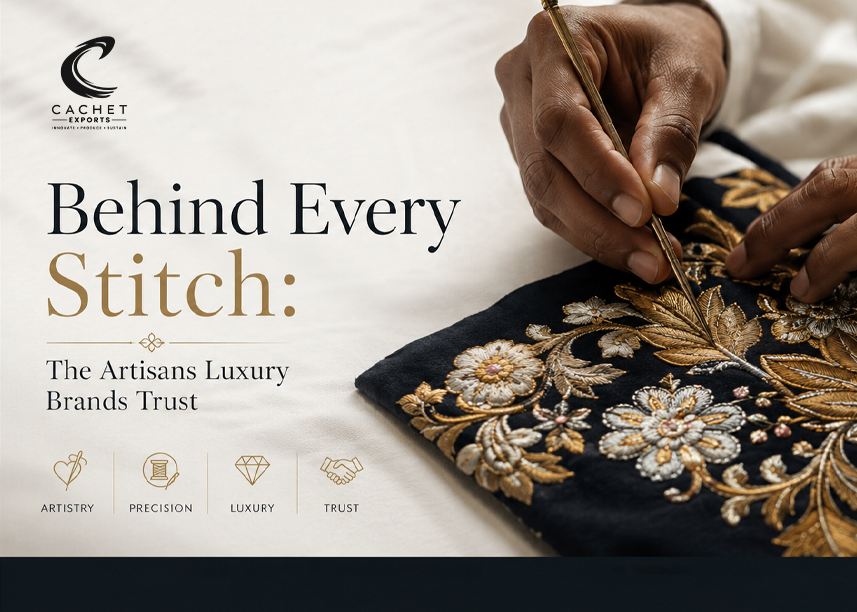
A hand-embroidered sample can look extraordinary and still come from a supply chain no one can account for. That gap — between what a swatch shows and what a factory can prove — is where most sourcing decisions in luxury embroidery go wrong.
Indian hand embroidery has moved from a background credit to a public one. Fashion houses that once kept their Indian ateliers quiet are now naming them. That shift has made buyers more comfortable searching openly for an embroidery export house in India — but it has also raised the bar for what "verified" means. A striking Instagram reel of needlework proves a technique exists somewhere. It proves nothing about who is holding the needle, under what conditions, or whether the person you're negotiating with is the manufacturer at all.
This guide sets out what a luxury buyer should check before committing a collection to a hand embroidery manufacturer in India — and why the single most important question is rarely the one buyer ask first.
This distinction matters more than almost any other factor in hand embroidery sourcing, for three reasons:
A hand embroidery garment supplier in India that hesitates to answer this question plainly, or that answers it vaguely, is telling you something. A manufacturer with a genuine in-house atelier will usually be glad to show you — through documentation, a virtual walkthrough, or a visit.
At Cachet Exports, embroidery is produced by artisans working within our own facility, not routed through subcontracted third-party units. That's a structural choice, not a marketing line — it's what makes consistency across a full production run possible in the first place.
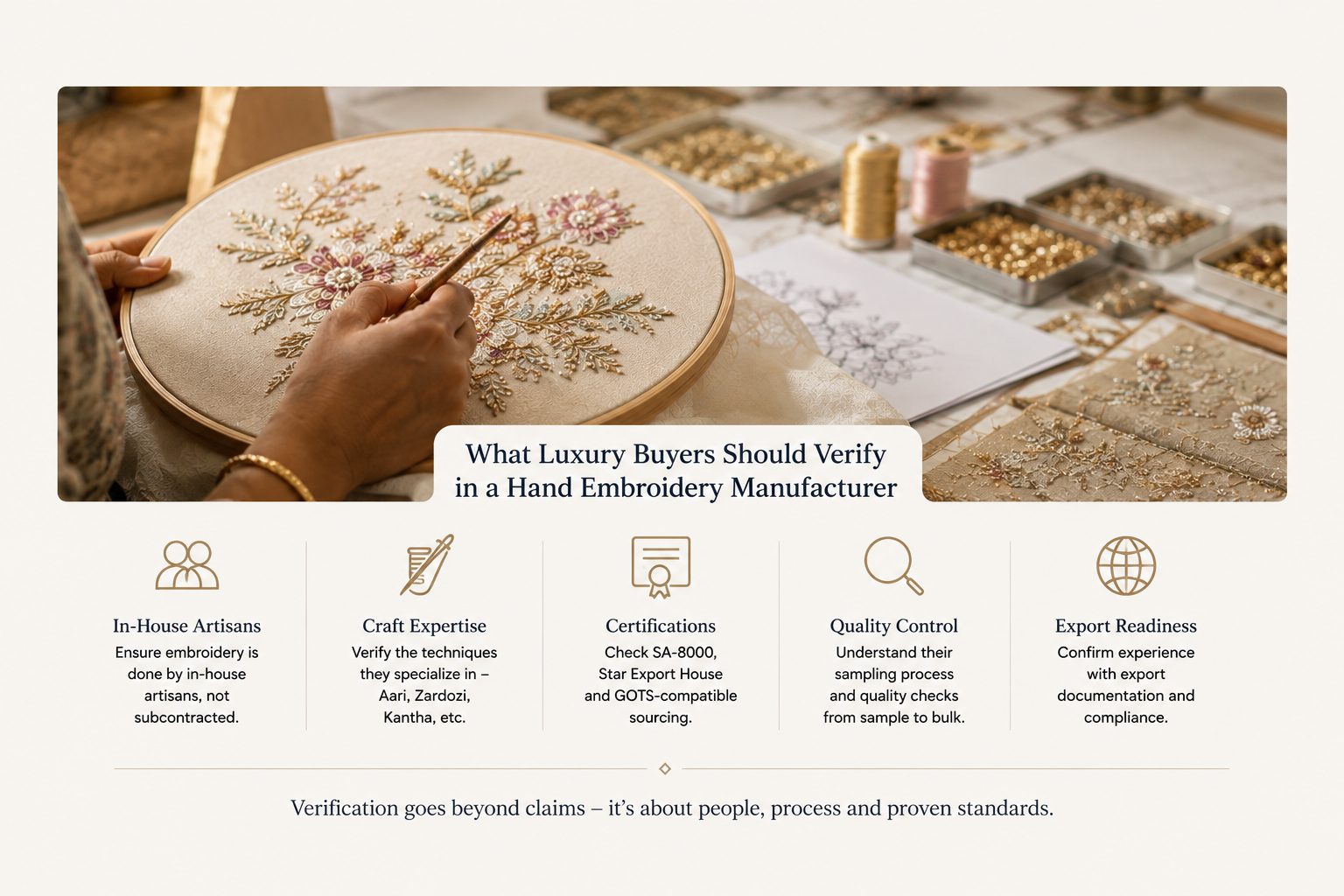
The value of verification is that the artifacts that are being protected are the objects of the craft. Indian Hand Embroidery is not a single technique it is a set of techniques, each with its own set of disciplines, tools and training lineage.
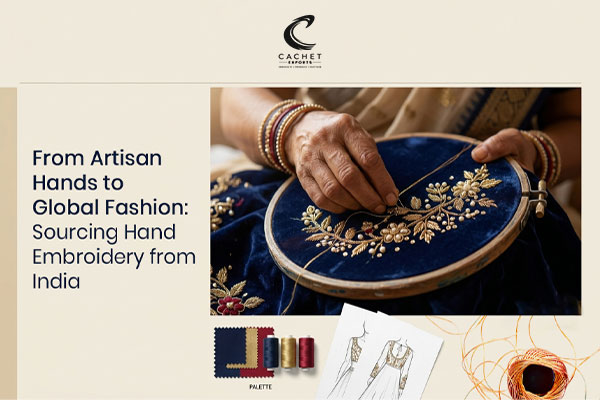
1. Aari embroidery uses a hooked needle worked from a frame to create continuous chain-stitch lines — the technique behind fine, flowing floral and paisley work often seen in couture eveningwear. It rewards artisans with years of frame training, since the hook's tension has to stay even across an entire panel.
2. Zardozi embroidery is metal-thread work — traditionally gold and silver wire, now more commonly a mix of metallic thread, sequins, and beads — built up in raised, dimensional patterns. It's the technique most associated with bridal and heavy occasion wear, and it demands artisans trained specifically in metal-thread handling, which is a different skill set from Aari.
3. Kantha embroidery is a running-stitch technique with roots in Bengal, traditionally used to layer and quilt fabric while creating surface texture and pattern. In contemporary luxury use, it's increasingly chosen for its handmade irregularity — the visible evidence of a human hand, which is precisely what mass production can't replicate.
A good embroidery export house in India should be able to talk to you about the techniques in which its embroiderers are trained and not present all three as a single menu. Ask about techniques that are applicable to your collection, and request to see work by the artist in that technique rather than a "showreel" of their work.
Certifications are of no value unless they are current and verifiable. Having a logo on a website is not enough, they ask for the certificate number and then compare it with the certificate number of the issuing body.
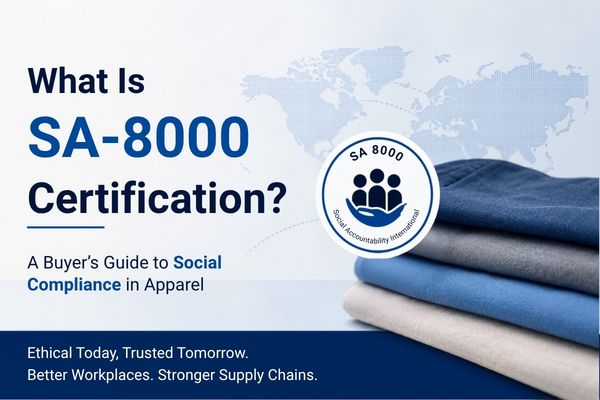
SA-8000 is a social accountability certification covering labour conditions — working hours, wages, health and safety, and freedom of association. For a luxury buyer under growing pressure to demonstrate ethical supply chain practices, a current SA-8000 certificate from a verified manufacturer is one of the more meaningful checks available, because it's independently audited rather than self-declared.
Star Export House status is a recognition issued by the Government of India to exporters meeting defined export performance thresholds. It's a credible signal of export track record and scale, worth confirming is current and correctly issued.
GOTS-compatible sourcing means a manufacturer works with GOTS-certified fabrics and materials where required — this is a distinct claim from being GOTS-certified as a facility, and a buyer should ask specifically which one applies to a given order, since the two are not interchangeable.
Beyond named certifications, ask any manufacturer directly: what audits has this facility undergone, when, and by whom? A manufacturer confident in its standards will have documentation ready. One that's vague on dates or auditor names is worth a harder look.
Cachet Exports is an SA8000-certified manufacturer and a Government of India-recognised Star Export House. This Company also supports initiatives associated with the Kailash Satyarthi Children’s Foundation and Panthera.
This is a working list to use in early supplier discussions – not every manufacturer will discuss all these points at once and that's good information to have.
None of these questions are unusual to ask. What separates a genuine manufacturer from a broker is simply how readily and specifically they can answer.
A luxury buyer isn't just sourcing embroidery — they're sourcing consistency across a limited, high-visibility run, often on a compressed timeline ahead of a show or launch. There's little room to discover mid-production that the artisans who produced your approved sample aren't the same ones producing the bulk order.
This is precisely why the in-house question matters more here than almost anywhere else in garment sourcing. A generic apparel order might tolerate some variability across a large run. A couture-adjacent embroidered piece, built around exact stitch density and hand-matched colour transitions, generally can't.
It's also why relationship depth matters over transaction speed. Verification isn't a one-time gate — it's the foundation for a working relationship where a manufacturer understands a brand's standards well enough to hold them consistently across seasons, not just a single collection.
At this point in the sourcing process, it is worth looking beyond claims and examining how a manufacturer operates. Cachet Exports is an SA-8000 certified Star Export House and a hand embroidery manufacturer in India working across aari, zardozi, and kantha techniques, with GOTS-compatible sourcing available where fabric requirements call for it. Embroidery is produced by artisans within our own facility — not routed through subcontracted external units — which is the structural basis for the consistency luxury collections require.
Our partnerships with the Kailash Satyarthi Foundation and Panthera reflect standards that extend beyond a single certificate, and we're glad to walk any prospective partner through documentation, technique specialisation, and facility practices directly, rather than asking a buyer to take any of it on faith.
If you're evaluating a hand embroidery garment supplier in India for an upcoming collection, we'd encourage you to run the checklist above with any manufacturer you're considering — including us.
1. What's the difference between a hand embroidery manufacturer and an embroidery export house?
Often used interchangeably, but "manufacturer" implies in-house production, while "export house" can mean coordinated, subcontracted work. Verify which one you're actually sourcing from.
2. How can I verify SA-8000 certification is genuine and current?
Ask for the certificate number and confirm it directly with the certifying body — don't rely on a logo alone.
3. Why does it matter whether embroidery artisans are in-house rather than subcontracted?
In-house artisans mean direct supervision, consistent quality, and clearer accountability than subcontracted work typically allows.
4. Is GOTS-compatible the same as GOTS-certified?
No. GOTS-compatible means the manufacturer sources GOTS-certified fabric. GOTS-certified means the facility itself holds the certification. Ask which applies to your order.
5. What should I ask for before approving bulk production after a sample?
Ask how consistency is maintained between sample and bulk — including whether the same artisans are used and how quality is checked.
.jpg)
.jpg)
Copyright © 2026 Cachet Export All rights reserved.
Powered by AGTS