Copyright © 2026 Cachet Export All rights reserved.
Powered by AGTS

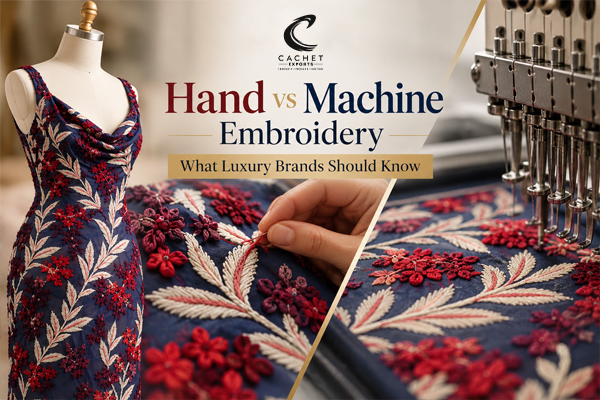
Most sourcing conversations about embroidery start with the supplier. But conversations about the technique should begin one step earlier. The choice between hand embroidery, machine embroidery or a combination of the two will influence virtually every subsequent stage—from the finish of the garment and its price to sample turnaround, bulk-production consistency and the type of manufacturer best suited to the project.
India is one of the few sourcing destinations where brands can get both at a high level, often from the same facility. That is an advantage, but only if the brief is clear about which technique belongs where. This guide explains the practical difference between hand and machine embroidery and how to decide which one your collection needs.
At Cachet Exports, we work across hand, machine and mixed-technique embroidery for international fashion brands, and this guide draws on what we see in sampling and production every day.
A brand that briefs "embroidery" without specifying the technique leaves the manufacturer to decide. That decision then shapes the price, the lead time and the look of the collection, often without the brand realising a choice was made.
Getting this right early helps in three ways:
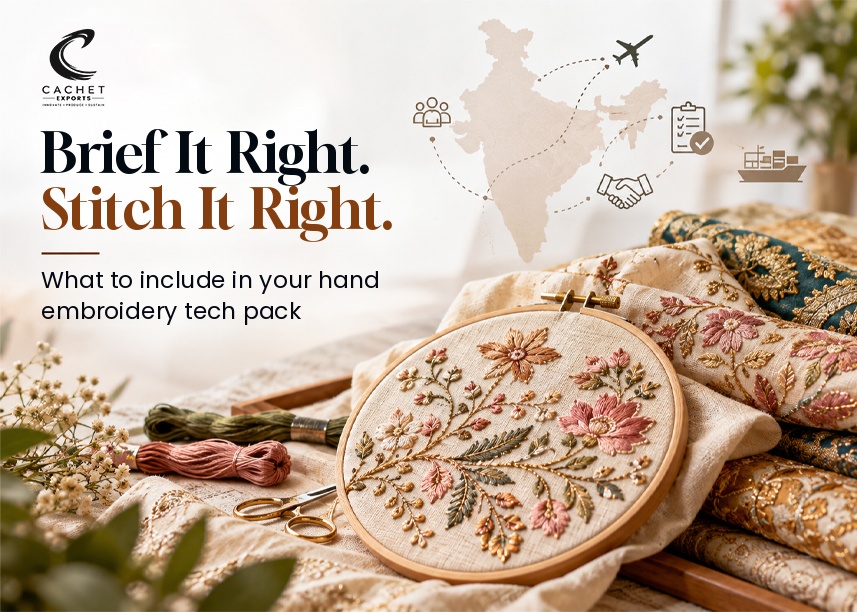
Hand embroidery is created stitch by stitch by skilled artisans typically on a frame. It's not about mass production; it's about depth, texture and the hand-finished quality that machines cannot fully replicate. and the hand quality that can't be duplicated by machines.
The most popular hand embroidery techniques are:
Ideal for couture, bridal, eveningwear, statement pieces, limited run, and any design that highlights the handmade aspect of the product.
Trade-offs: longer lead times, higher cost per piece and some natural variation from one piece to another within a run. A competent team reduces that variation but it can be eliminated only to a limited extent.
Machine embroidery is the use of a computerised embroidery machine to embroider a digitised design. It is possible to create very fine, high-quality work on modern machines if suitable threads are used and the work is skillfully digitised.
Techniques that work well by machine include:
Best suited to ready to wear collections, resort collections, repeat styles, higher quantities, and designs where uniformity is important for each garment.
Trade-offs: less dimensional depth than hand work, and a finish that some luxury buyers consider less distinctive for statement pieces.
|
Factor |
Hand Embroidery |
Machine Embroidery |
|
Finish |
Dimensional, textured, artisanal |
Clean, uniform, precise |
|
Cost per piece |
Higher |
Lower |
|
Lead time |
Longer |
Shorter |
|
Consistency |
Natural variation |
Highly consistent |
|
Best volume |
Limited and mid-sized runs |
Mid to large runs |
|
Design changes |
Flexible at sampling stage |
Requires re-digitising |
|
Typical use |
Couture, bridal, evening |
RTW, resort, repeat styles |
Haute Couture and Bridal. Hand embroidery is almost always the right call. Zardozi, Aari and dimensional techniques like French knots give these pieces the weight and richness buyers expect at this level.
Evening Wear. Usually hand-led, often with machine work in supporting areas. Hand embellishment works on the focal points, such as the bodice, neckline and hem, while machine work handles the larger surface areas.
Resort Wear. A strong fit for either technique. Machine thread embroidery suits lighter, repeatable designs. Hand techniques like Kantha add a relaxed, artisanal feel.
Ready-to-Wear. Machine embroidery is generally preferred over hand embroidery for consistency and pricing between sizes and colourways, while hand embroidery is only used in signature styles.
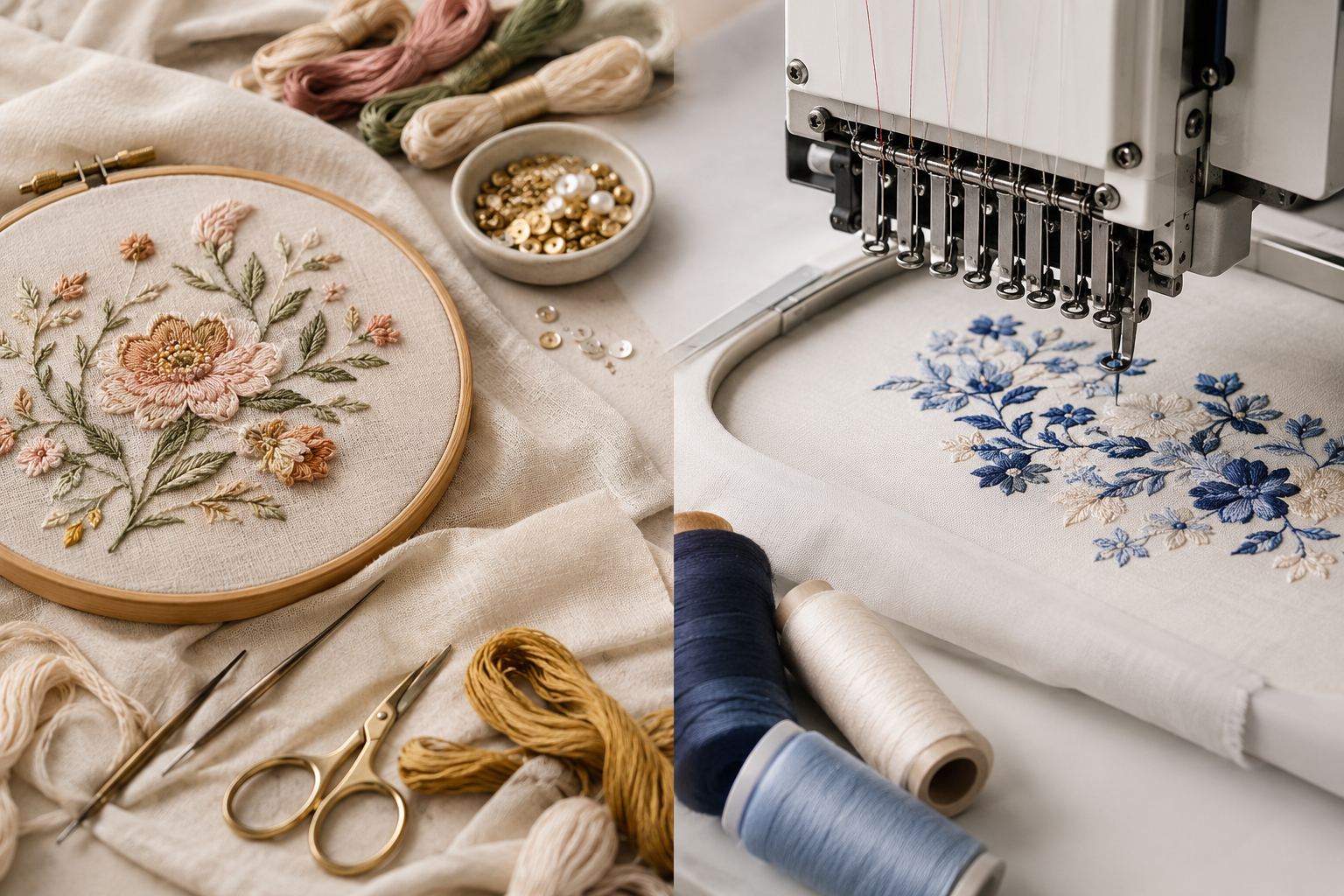
Many of the most effective luxury designs are not purely hand or purely machine. A mixed technique approach uses machine embroidery for the base structure, such as outlines and fills, and adds hand embellishment on top: sequins, knots, metal thread or beading.
This approach can:
For brands balancing a luxury finish with commercial volumes, mixed technique is often the most sensible brief.
The same hand and machine decision applies to accessories. The technique must be matched to the product in the case of embroidered bags, shoes, belts, headwear and panels. Machine stitching or reinforced hand work is used for pieces that are subjected to wear and friction on the regular. Decorative panels can be hand embellished more delicately.
Before briefing a collection, ask any supplier:
A capable manufacturer will answer these clearly and advise you on the technique rather than simply quoting it. To obtain a more detailed list of certifications and production methods, view our guide on how to verify a hand embroidery manufacturer in India.
In neither is one superior in all instances. Hand embroidery provides lots of depth and artisanal quality. Machine embroidery is more consistent, faster and cheaper. The right choice is dependent on the collection, price point and volume. A manufacturer limited to one technique will naturally steer every brief towards it. One that works in both can recommend what suits the design, the price point and the timeline.
At Cachet Exports, we help brands choose hand, machine or mixed technique piece by piece, so every design gets the embroidery it truly needs. The strongest partners also combine design development support, sampling discipline and compliance credentials, so the technique decision sits within a reliable production process rather than being made in isolation.
Cachet Exports is an SA-8000 certified, Government of India-recognised Star Export House working with international fashion brands across RTW, Haute Couture, Resort, Bridal and Evening wear. Our embroidery range covers both hand techniques, including Zardozi, Hand Aari, French knots, couching, cord work and Kantha-inspired running stitch, and machine techniques, including chain stitch, satin stitch and silk, cotton, wool and lurex cord work.
Our dedicated embroidery development team works with designers to turn sketches, references and mood boards into production-ready embroidery, and advises on where hand, machine or mixed technique will serve the design best. We also produce bespoke embroidery for bags, shoes, belts, headwear and panels, with GOTS-compatible fabric sourcing available where required.
If you are shortlisting the best embroidered garment manufacturers India offers for your next collection, explore our embroidery capabilities or contact our team to discuss technique options for your designs.
1. Is hand embroidery better than machine embroidery?
In neither is one superior in all instances. Hand embroidery provides lots of depth and artisanal quality. Machine embroidery is more consistent, faster and cheaper. The right choice is dependent on the collection, price point and volume.
2. Why is hand embroidery more expensive?
They are hand stitched and this method takes a lot longer than machine stitching, particularly for intricate stitching such as Zardozi or Aari.
3. Can hand and machine embroidery be used on the same garment?
Yes. Mixed technique embroidery usually involves embroidering the base with a machine while adding hand embroidery to add highlights, and balancing the finish, cost and lead time.
4. Which embroidery is best for ready-to-wear collections?
RTW is typically embroidered and then hand-stitched with details for signature styles, as hand embroidery can be inconsistent in colour and size across the different versions of each style.
5. How can I tell whether a sample is hand or machine embroidered?
Hand embroidery typically shows slight irregularity, raised texture and dimensional work. Machine embroidery looks more uniform. Ask the manufacturer to label each sample's technique.

Copyright © 2026 Cachet Export All rights reserved.
Powered by AGTS