Copyright © 2026 Cachet Export All rights reserved.
Powered by AGTS

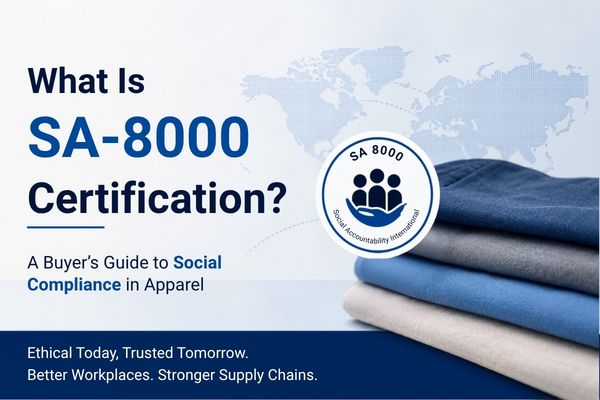
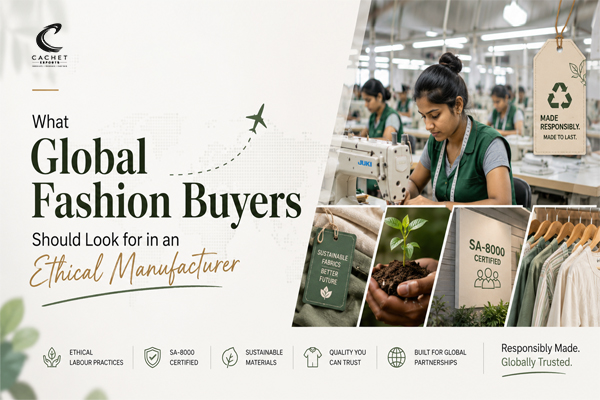
For most of the last two decades, a buyer could treat labour conditions as a supplier's private business. That era is over. If the garment comes up in a news cover or an NGO report, it is the brand on the label that suffers, not the factory, three steps away on the supply chain. Social compliance is no longer a marketing and values statement on a company's website, it has become a requirement of doing business and the best way to prove this is to have an independent third-party certification, not a company's own statement.
The most known certification for this is SA-8000. Whether you are a buyer or a supplier, this guide tells you what it is, how it's being awarded, how it differentiates itself from the other schemes buyers often mistake it for, and what to look for to be sure that what you're getting is legitimate before you place the order.
Social Accountability International (SAI) established the international standard for social accountability in the workplace (SA-8000) in 1997. It establishes an auditable framework for an organisation to operate under to ensure that their employees are treated in accordance with the Universal Declaration of Human Rights, the essential conventions of the International Labour Organisation (ILO) and the national labour law.
The key difference is that SA-8000 isn't a self-declared code of conduct. It is a third-party audit certification awarded only after an independent, accredited certifying body has visited the facility and found it compliant with the Standard and has been monitoring the facility. A supplier must be audited by an external auditor not controlled by the supplier, and the audit must be conducted against SA-8000 multiple times.
The Standard is updated from time to time. The previous edition was SA8000:2014, which included additional tool, a management system, called Social Fingerprint, to encourage continual improvement. SAI has since issued and published SA8000:2026 and organisations that have been certified are moving up to the new version. A current certificate issued by an ethical garment manufacturer, which may be issued in India or elsewhere, should embody the edition in that time which was in force when the audit was carried out.
SA-8000 evaluates an organisation on nine elements. There are eight cover performance areas – the ninth, the management system, is what holds the others together in everyday life – not just on audit day.
For a buyer, the value is that these are not aspirations. Each is something an auditor verifies through evidence, not a paragraph a supplier writes about itself.
|
Aspect |
How It Works |
|
Who certifies |
Independent certification bodies, accredited and overseen by Social Accountability Accreditation Services (SAAS). |
|
Why accreditation matters |
Only certificates issued by SAAS-validated auditors are recognised as credible; an unaccredited certificate is not considered equivalent. |
|
What the audit covers |
Document review, on-site inspection, and separate interviews with workers and management, followed by verification that any identified non-conformities have been corrected. |
|
Certificate validity |
Three years. |
|
Ongoing monitoring |
Surveillance audits are conducted at intervals throughout the certification cycle to confirm that compliance is maintained continuously rather than staged for a single inspection. |
|
Global scale (per Social Accountability International) |
Approximately 2.8 million workers are employed across more than 5,000 certified facilities worldwide. |
However, it is widely believed that much of the obligation for supply-chain due diligence is over after the EU's Omnibus reform of 2026. It has been reduced to a much smaller size, but it has not gone away. Obligations to report and due-diligence remain in the post-Large in-Scope environment and the same goes for the flow of information requests to suppliers. When you are selling to those brands, your own qualifications lend to their compliance tale.
Even setting regulation aside, the commercial case stands on its own:
Hence, "ethical" cannot be a marketing term and "SA-8000" certified can be a true statement. Today, customers looking for an ethical fashion supplier in India, or anywhere else, are looking to buy based on the certificate that comes with the label. A SA-8000 certified garment manufacturer can produce one, but a supplier using his or her code of conduct cannot.
Social compliance terminology is crowded, and the labels are not equivalent. A short comparison helps when you are reading a supplier's credentials.
None of these makes the others redundant.
Make the claim and try to prove it, don't assume it. There are four checks between a legitimate certificate and a logo in a home page:
A supplier that answers these openly is showing you the transparency you want in a manufacturing partner. Hesitation is itself information.
Cachet Exports is an SA-8000 certified garment manufacturer and a Government of India recognised Star Export House, producing scarves, garments, hand embroidery, and printed fabrics for brands worldwide. The SA-8000 certificate is not a line in a brochure for us; it reflects how the facility is run, and we are glad to share documentation as part of any buyer's due diligence.
That's a result of a larger commitment in responsible manufacturing. Our products are vertically integrated and handcrafted by weavers, embroiderers and crafts persons from various parts of India who are dedicated to environmental sustainability, empowering the women, skilling and social wellbeing. We accommodate the production of GOTS certified fabrics for brands wanting to use certified organic fabrics and collaborate with organisations such as Kailash Satyarthi Foundation and Panthera. We advocate our own credentials only, as we expect to receive from any supplier.
You can read more on our sustainability page, explore ourgarment and hand embroidery capabilities, or see our practical guide to sourcing hand embroidery from India for how a project moves from brief to delivery.
Social compliance is no longer a question you can leave to a supplier's discretion, and SA-8000 is the clearest independent answer to it. If you are evaluating manufacturing partners in India and want a supplier whose ethical credentials are documented rather than asserted, we would be glad to talk.
Speak to the Cachet Exports team about your project or request a sample. Enquire today.
SA 8000 is an internationally accepted certification which proves that a company has responsible and safe labour practices that have been verified by independent third parties through audit.
No. SA-8000 is applicable to companies in all industries, but is commonly used in the textile and apparel supply chains.
The SA-8000 certificate will expire after three years while regular surveillance audits will ensure continued compliance.
No. GOTS emphasizes on organic materials and environmental processing, while SA-8000 is concerned with labour rights and social accountability.
Request the certificate from him, verify that it was issued by a SAAS accredited certifying body and double-check on the effective dates and scope of certification.


.jpg)
.jpg)
Copyright © 2026 Cachet Export All rights reserved.
Powered by AGTS