Copyright © 2026 Cachet Export All rights reserved.
Powered by AGTS

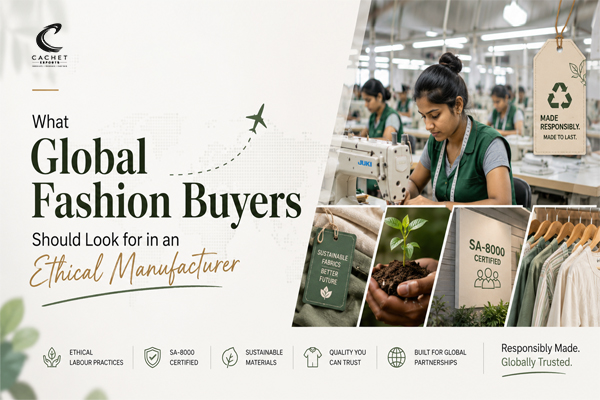
Every sourcing brief seems to include the word "ethical" now. Every supplier claims it. And somewhere between the RFP and the factory floor, the word has stopped meaning very much at all.
If you're a sourcing manager or sustainability director evaluating manufacturers in India, "ethical" isn't a checkbox — it's shorthand for three or four separate things you need verified. Knowing what those things are makes supplier evaluation faster, and makes it much harder for a factory to talk its way past a real audit.
There is no legal definition for ‘ethical' and no single certifying body. A manufacturer can have it printed on the homepage without having to retain any third-party audit. It's not necessarily deceptive — it's just not accurate. As a buyer, you need to break down the word to the specific claims it is replacing and determine which of the claims the manufacturer can prove.
When a European or US consumer claims that they want an ethical clothing manufacturer in India, they are likely referring to one or more of the following four points in practice.
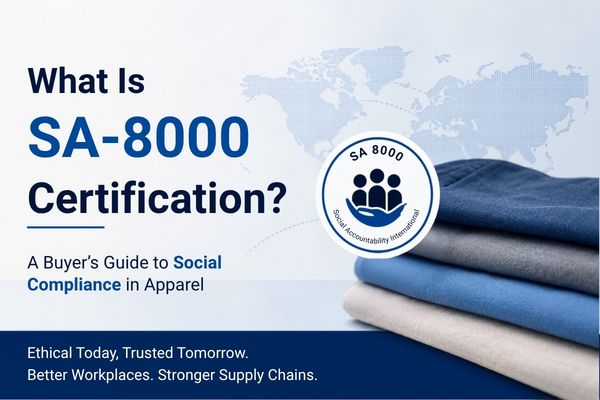
This is the part of "ethical" that has an actual certification behind it: SA-8000. SA-8000 is a third-party social accountability standard covering child labor, forced labor, health and safety, freedom of association, working hours, and disciplinary practices, audited against documented evidence rather than a factory's own claims.
When you're assessing a SA-8000 certified garment manufacturer, ask for the certificate number and audit date directly — a legitimate certification is verifiable, not just claimed. This single credential covers most of what buyers mean by "ethical" on the labor side, and it's the credential worth prioritizing over vaguer language on a supplier's website.
Cachet Exports holds SA-8000 certification, alongside recognition as a Star Export House from the Government of India.
The second thing buyers usually mean by "ethical" is environmental: how fabric is sourced, dyed, and processed, and whether the inputs meet recognized sustainability standards.
Here comes the point of overlap between the words "sustainable" and "ethical. If you are looking for a sustainable garment manufacturer in India, it should be able to answer you the specific certification it applies on which fabric: not just say that they follow the principle of sustainability. Where a supplier uses organic cotton or any other certified material, this should be specified, fabric by fabric, and not be used as a blanket claim for the entire product line.
When it comes to sourcing, Cachet Exports works with GOTS-compatible fabrics where they apply — we don't claim certification beyond what the fabric itself carries.
The third layer is visibility: does the manufacturer know — and disclose — where its raw materials and sub-processes come from? For buyers navigating the EU's Corporate Sustainability Reporting Directive (CSRD) or similar due diligence obligations, this isn't optional anymore. Regulators and retail partners increasingly expect documented traceability, not a general assurance that "we work with trusted partners."
This is a fair question to put directly to any manufacturer during evaluation: what can they show you, not just tell you.
The fourth thing some buyers mean by "ethical" goes past minimum compliance into active social contribution — partnerships that support artisan communities, women's livelihoods, or child welfare in the regions a factory operates in.
Cachet Exports partners with the Kailash Satyarthi Foundation, and Panthera. We treat these as complements to certification, not substitutes for it — a factory's social partnerships don't replace the need for an SA-8000 audit, and we'd encourage you to evaluate them as two separate questions.
When you're comparing manufacturers, it's worth asking each one:
A manufacturer that answers these precisely is telling you something real. One that responds only with "we're fully ethical and sustainable" is telling you very little.
"Ethical manufacturer" isn't a standard you can audit against — SA-8000, GOTS-compatible sourcing, and documented supply chain transparency are. When you're evaluating a sustainable garment manufacturer in India, ask for the specific credential behind the word, not just the word itself.
Cachet Exports is a SA-8000 certified garment manufacturer and Star Export House working across our garments and our hand embroidery, with GOTS-compatible sourcing applied where the fabric supports it. You can review our certifications and partnerships on our sustainability page, or request a sample to see the standards in practice.

.jpg)
.jpg)
Copyright © 2026 Cachet Export All rights reserved.
Powered by AGTS